
WELCOME BONUS 300%
UP TO €2000 + 100
FREE SPINS
UP TO €2000 + 100
FREE SPINS
Home → Blackjack
Blackjack at Slim King Casino: Variants, Rules and Payouts
Bet Two Percent of Your Bankroll per Hand
Blackjack 6 decks, S17, DAS, DOA, 3:2 payout, basic strategy carries an RTP of 99.54% and a house edge of 0.46%. The house edge is the average share of each stake that the casino keeps, so 100 € of stakes cost 0.46 € on average. At a 2% bet size on a 1,000 € bankroll, that is 20 € per hand, and 100 such hands cost about 9.20 € in expected losses.
Compare that with Blackjack 6:5 payout instead of 3:2 on 6 decks, where the RTP drops to 98.15% and the house edge rises to 1.85%. The 1.39 percentage point gap between 0.46% and 1.85% means 100 € of stakes cost 1.85 € instead of 0.46 €. On a €10 bet, a blackjack pays €12 at 6:5 instead of €15 at 3:2, a €3 difference per blackjack.
A smaller bet size does not change the house edge, only the euro amount at risk. Blackjack Single deck, classic rules, 3:2 shows an RTP of 99.85% and a house edge of 0.15%, so 100 € of stakes cost 0.15 € on average. At 2% of a 1,000 € bankroll, that is 20 € per hand, and the long-run cost per 100 hands is about 3 €.
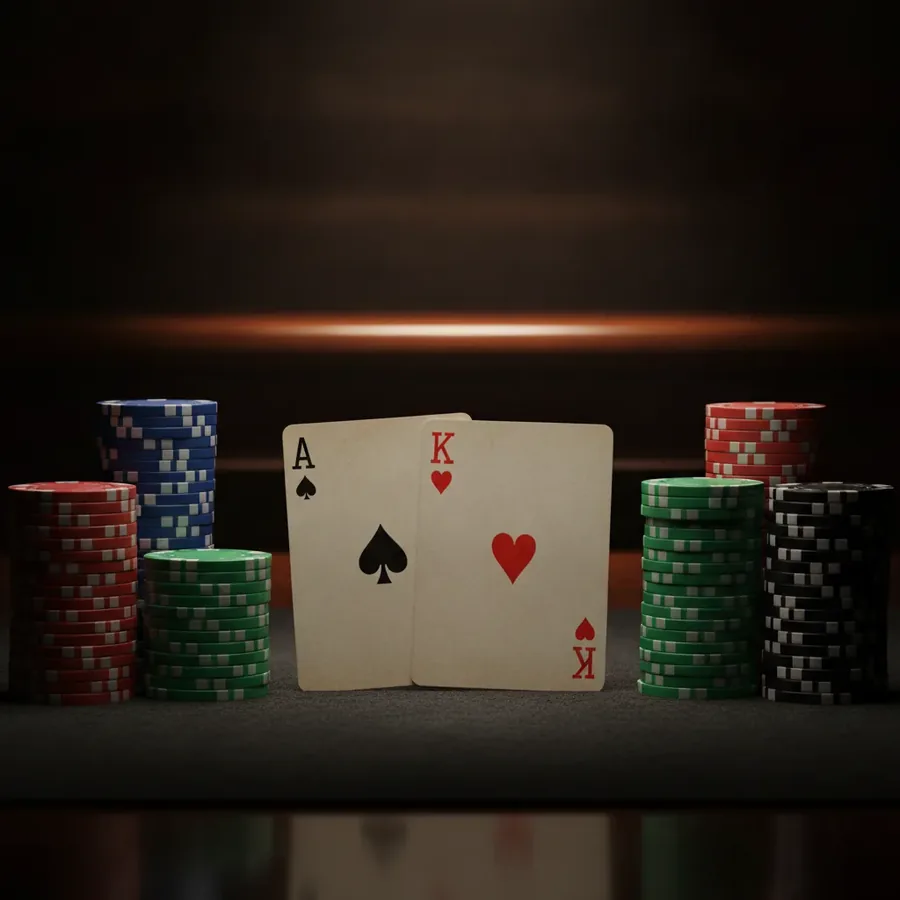
How many decks are in the shoe?
Blackjack Single deck, classic rules, 3:2 carries an RTP of 99.85% and a house edge of 0.15%. Using 6 decks instead of 8 changes the house edge by about 0.02 percentage points, while one deck gives about −0.48 percentage points compared with 8 decks. The deck count therefore moves the house edge by less than half a percentage point across the common shoe sizes.
Blackjack 6 decks, S17, DAS, DOA, 3:2 payout, basic strategy sits at an RTP of 99.54% and a house edge of 0.46%. The gap to the single-deck figure is 0.31 percentage points, which on 100 € of stakes is 0.31 €. A 6:5 payout on the same 6 decks lifts the house edge to 1.85%, far more than the deck count itself.
Blackjack Liberal Vegas Strip with liberal rules and a 3:2 payout shows an RTP of 99.72% and a house edge of 0.28%. It combines S17, DAS, resplit and late surrender, and its standard deviation is 1.15. Rule quality moves the figure more than the number of decks, so the payout ratio matters before the shoe size does.
Splitting Eights vs Standing on 16
Splitting is a rule effect rather than a fixed RTP: split allows up to 4 hands, and split aces usually get one card each. Doubling after a split improves the return by about 0.14 percentage points, while resplitting aces improves it by 0.08 percentage points. On 100 € of stakes, the DAS effect is worth about 0.14 € and the resplit aces effect about 0.08 €.
Blackjack 6 decks, S17, DAS, DOA, 3:2 payout, basic strategy reaches an RTP of 99.54% with a house edge of 0.46%. Doubling after a split is already included in that figure, so a table without DAS would sit about 0.14 percentage points lower. On a €10 bet, that difference is roughly €0.014 per hand in expected value.
Blackjack Liberal Vegas Strip with liberal rules and a 3:2 payout lists an RTP of 99.72% and a house edge of 0.28%, and it includes resplit alongside S17, DAS and late surrender. Its standard deviation is 1.15. Late surrender alone improves the return by about 0.08 percentage points, and the player gives up the hand after the dealer has checked for blackjack and loses half the stake.
Ignoring the Basic Strategy Chart: 1 Percent Wasted
Blackjack 6 decks, S17, DAS, DOA, 3:2 payout, basic strategy carries an RTP of 99.54% and a house edge of 0.46%, but basic strategy is required to reach this figure. The 0.18 percentage point gap between 0.46% and 0.28% amounts to 0.18 € per 100 € staked.
Blackjack 6:5 payout instead of 3:2 on 6 decks sits at an RTP of 98.15% and a house edge of 1.85%. Replacing 3:2 with 6:5 adds exactly 1.39 percentage points to the casino's edge, more than any other rule change. On a €10 bet, a blackjack pays €12 instead of €15, so 100 € of stakes cost 1.85 € rather than 0.46 €.
Blackjack Insurance on 6 to 8 decks carries an RTP of 92.53% and a house edge of 7.47%, and basic strategy always declines it except for card counters at a true count of at least +3. Insurance pays 2:1 but lowers the return in the long run. With a single deck the edge is about 5.88%, so 100 € of insurance stakes cost 5.88 € on average.
Soft 17: Does the Dealer Hit or Stand?
Dealer hitting soft 17 lowers RTP by 0.22 percentage points, and the same rule change adds +0.22 percentage points to the house edge. On 100 € of stakes, that rule alone costs 0.22 € more than a stand-on-soft-17 table. Resplitting aces improves the return by 0.08 percentage points, and doubling after a split improves it by about 0.14 percentage points.
Blackjack 6 decks, S17, DAS, DOA, 3:2 payout, basic strategy reaches an RTP of 99.54% with a house edge of 0.46%, and the dealer stands on soft 17. Blackjack Liberal Vegas Strip with liberal rules and a 3:2 payout also uses S17 and shows an RTP of 99.72% with a house edge of 0.28%. The 0.18 percentage point gap between the two equals 0.18 € per 100 € staked.
Blackjack Single deck, classic rules, 3:2 carries an RTP of 99.85% and a house edge of 0.15%, and one deck gives about −0.48 percentage points compared with 8 decks. A 6:5 payout on the same game would cut the blackjack return from €15 to €12 on a €10 bet. The dealer rule and the payout ratio therefore move the figure independently of the deck count.
Blackjack variants at a glance
| Variant | Payout | House edge | Rule | RTP |
|---|---|---|---|---|
| Blackjack 6 decks, S17, DAS, DOA, 3:2 payout, basic strategy | Blackjack 3:2, regular win 1:1, insurance 2:1 | 0.46% | Dealer stands on soft 17; double down on any first two cards; doubling after a split allowed; no surrender. Basic strategy is required to reach this figure | 99.54% |
| Blackjack Liberal Vegas Strip (liberal rules, 3:2) | Blackjack 3:2, win 1:1 | 0.28% | The most player-friendly rule set: S17 + DAS + resplit + late surrender. Standard deviation 1.15 | 99.72% |
| Blackjack Insurance (6–8 decks) | Insurance 2:1 | 7.47% | Separate side bet of up to 50% of the main bet when the dealer shows an ace. Basic strategy ALWAYS declines it (except for card counters at a true count ≥ +3). With a single deck the edge is ≈ 5.88% | 92.53% |
| Blackjack Split / double / H17 – rule effects | Double – stake ×2 with one card; split – up to 4 hands; split aces usually get one card each. | H17 +0.22 percentage points; RSA −0.08 percentage points; DAS −0.14 percentage points | Dealer hitting soft 17 lowers RTP by 0.22 percentage points; resplitting aces improves it by 0.08 percentage points; doubling after a split improves it by about 0.14 percentage points; 6 decks instead of 8 – about 0.02 percentage points. | n/a (rule modifiers) |
| Blackjack Surrender (late surrender) – rule effect | 50% of the stake returned | −0.08 percentage points | The player gives up the hand after the dealer has checked for blackjack and loses half the stake. Improves RTP by about 0.08 percentage points. Early surrender is worth much more (up to −0.6 percentage points) but is extremely rare. | n/a (rule modifier) |
| Blackjack 6:5 payout instead of 3:2 (6 decks) | Blackjack 6:5, win 1:1 | 1.85% | Replacing 3:2 with 6:5 adds exactly +1.39 percentage points to the casino's edge – more than any other rule change. On a €10 bet a blackjack pays €12 instead of €15. | 98.15% |
Even Money only possible with Dealer Ace
The even money option appears only when the dealer shows an ace and the player holds a blackjack. On a €100 stake, taking even money locks in a €100 profit immediately, while the standard 3:2 payout would return €150 if the dealer does not also have blackjack. The dealer checks for blackjack before the player must decide, so the choice is made with complete information about the dealer's hand.
Blackjack 6:5 changes this calculation substantially. A €10 bet pays €12 instead of €15 under the 6:5 rule, which adds exactly 1.39 percentage points to the casino's edge. Even money is not offered on 6:5 tables in the same way, because the reduced payout already alters the value of a player blackjack before any dealer ace appears.
The house edge for classic single deck blackjack with 3:2 payouts is 0.15%, while 6:5 single deck carries a 1.85% edge. Insurance, a separate side bet of up to 50% of the main bet when the dealer shows an ace, pays 2:1 but has a 7.47% house edge with 6–8 decks. Basic strategy always declines insurance except for card counters at a true count of +3 or higher.
Clicked Too Late? The Hand Stands Automatically
When the decision timer expires, the hand is automatically held rather than hit or doubled. This default protects the player from an unwanted card, but it also means a planned double down on 11 against a dealer 6 never occurs if the click arrives too late. The stake remains in play and the hand is resolved against the dealer's final total.
Doubling down requires the player to stake an additional amount equal to the original bet and receive exactly one card. In Blackjack Liberal Vegas Strip, doubling after a split is allowed and improves the return by about 0.14 percentage points compared with rules that forbid it. The standard edge for that variant is 0.28%, the most player-friendly figure in the comparison.
Timing constraints matter most at live tables with bet ranges. Lightning Blackjack by Evolution accepts 1 to 2,500 EUR and uses unlimited players, so many decisions must be processed within the same window. Blackjack Party runs with a 1.00 to 1,000 EUR range and two hosts, where a late click on a side bet such as Any Pair simply means no side stake is placed.
The Insurance Mistake: 7% Extra House Edge
Insurance is a separate side bet of up to 50% of the main bet when the dealer shows an ace. The payout is 2:1, but the house edge for 6–8 decks is 7.47%, which means the casino keeps 7.47% of every insurance stake on average over time. Basic strategy always declines this bet except for card counters at a true count of at least +3.
With a single deck the insurance edge is approximately 5.88%, still far worse than the 0.15% house edge of classic single deck blackjack with 3:2 payouts. A player who insures a €100 blackjack for €50 is risking a side bet with a 7.47% edge even though the main hand may already pay 3:2 at €150. The insurance outcome is independent of the player's own cards.
Late surrender, by contrast, improves the return by about 0.08 percentage points. The player gives up the hand after the dealer checks for blackjack and loses half the stake. This rule is available in Blackjack Liberal Vegas Strip, whose 99.72% RTP and 0.28% house edge already include late surrender along with S17, DAS, and resplitting.
Surrender or Play On With 16 Against a 10
Late surrender lets a player give up the hand after the dealer checks for blackjack and lose 50% of the stake. On a €100 bet against a dealer 10, surrendering returns €50 immediately, while playing out a 16 against that 10 carries a significant long-run loss because the dealer stands on 17 or higher and the player must draw to a very narrow range.
The rule improves RTP by about 0.08 percentage points, which is small but meaningful in Blackjack Liberal Vegas Strip where the house edge is already 0.28%. Early surrender is worth up to 0.6 percentage points but is extremely rare and does not apply to the listed tables. A player holding 16 versus a dealer ace should consider that the dealer has already checked for blackjack before surrender is allowed.
Blackjack 6 decks with S17, DAS, DOA and 3:2 payout has a 99.54% RTP and a 0.46% house edge, but that variant does not include surrender. The 6:5 payout rule adds 1.39 percentage points to the casino's edge, making a €10 blackjack pay €12 instead of €15. Surrendering a 16 against a 10 under a 6:5 table does not recover the loss already embedded in the reduced blackjack payout.
Infinite Blackjack vs the Classic Seven-Seat Table
Infinite Blackjack by Evolution accepts 1 to 5,000 EUR and offers unlimited seats at the table, along with four side bets: Any Pair, 21+3, Hot 3, and Bust It. The RTP is 99.47%, which places it below the 99.56% of Lightning Blackjack but above the 98.15% of 6:5 blackjack. Every player shares the same initial cards and then decides independently.
A classic seven-seat table with single deck and 3:2 payouts carries a 0.15% house edge and a 99.85% RTP, the best figure among all listed variants. Fewer decks reduce the edge by about 0.48 percentage points compared with eight decks, but this advantage disappears if the table pays 6:5 instead of 3:2. Blackjack Party by Evolution runs 1.00 to 1,000 EUR and uses two hosts, but its edge depends on the underlying rules.
The practical difference is decision speed and side bet availability. Infinite Blackjack processes unlimited players, so a late click results in an automatically held hand, while a seven-seat table gives each player a fixed window. Blackjack Liberal Vegas Strip includes S17, DAS, resplit, and late surrender for a 0.28% house edge, but it is not an unlimited-seat product. Side bets such as insurance carry a 7.47% edge, far higher than the main game.
Continuous Shuffling Machines Reshuffle After Every Round
A continuous shuffling machine returns every card to the shoe after each round, so the composition of a six-deck or eight-deck blackjack game stays close to a full pack at all times. That matters because fewer decks lower the house edge: a single deck at classic rules and a 3:2 payout returns 99.85%, while eight decks sit about 0.48 percentage points lower.
The comparison with a six-deck game shows the same direction. A six-deck table with S17, DAS and DOA reaches an RTP of 99.54% and a house edge of 0.46% only under basic strategy, and switching from eight decks to six is worth roughly 0.02 percentage points. A machine that reshuffles after every round keeps the pack near the eight-deck state.
For a reader staking €100 per round, the house edge of 0.46% at the six-deck table costs €0.46 on average, while the figure of 0.48 percentage points that separates one deck from eight decks is the price of the extra cards in play. The shuffling itself does not change the payout of 3:2 on a blackjack or 1:1 on a regular win.
Blackjack Party Has Two Hosts
Blackjack Party from Evolution is a live blackjack table with a bet range of €1.00 - €1,000 and two hosts presenting the game. The two hosts sit outside the dealing procedure, so the underlying blackjack rules and the 1:1 payout on a regular win remain the same as at a standard live table. The presentation is the distinguishing feature, not the odds.
Placing that range next to other live tables shows where it sits. Lightning Blackjack from Evolution accepts €1 - €2,500 and returns 99.56%, while Infinite Blackjack from Evolution spans €1 - €5,000 and returns 99.47%. The €1,000 top of Blackjack Party is therefore the lowest ceiling of the three, and the €1.00 minimum matches the entry level of the other two.
A player staking €1,000 at the top of the Blackjack Party range is risking the full ceiling of that table, while the same €1,000 at Infinite Blackjack sits below its €5,000 limit. The two hosts add presentation, and the RTP of the game itself is not tied to the bet size within the published range.
No Doubling Down on Three Cards
Doubling down means the stake is multiplied by two and the player receives exactly one more card, and at the six-deck table with S17, DAS and DOA the option is allowed on any first two cards. Once a third card has been drawn the hand is past the point where a double is permitted, so the rule is a restriction on timing rather than on the wager.
The value of the double is visible in the rule effects. Doubling after a split improves the return by about 0.14 percentage points, and resplitting aces adds 0.08 percentage points, while a dealer who hits soft 17 lowers the RTP by 0.22 percentage points. A six-deck game instead of eight decks is worth roughly 0.02 percentage points.
The six-deck game with S17, DAS and DOA reaches 99.54% RTP and a 0.46% house edge only under basic strategy, and the double is part of that strategy. A player who cannot double on three cards loses the option to press the bet after seeing an extra card, which is the situation the rule creates.
What the Peek Means When the Dealer Shows an Ace
When the dealer shows an ace, the house checks the hole card for a blackjack before play continues, and that check is what the term peek describes. At Blackjack Insurance the side bet of up to 50% of the main stake is offered when the dealer shows an ace, and it pays 2:1 but returns only 92.53% over six to eight decks and 92.53% with a single deck sitting near a 5.88% edge.
Insurance is the bet tied to the peek. Its house edge of 7.47% over six to eight decks compares with the 0.46% edge of a six-deck game with S17, DAS and DOA, so the side bet costs more than sixteen times as much per euro staked in the long run. Basic strategy always declines insurance except for card counters at a true count of at least +3.
Late surrender, by contrast, is used after the dealer has checked for blackjack, and it returns half the stake while improving the RTP by about 0.08 percentage points. A player facing a dealer ace therefore has two separate decisions: whether to take the 2:1 insurance bet, and whether to surrender the hand for 50% of the stake.
Contact
Live - online chat
Banking









Providers












Slim King Casino 2026